Development
Development
The development of the Mozambique LNG Project involves a series of carefully managed steps, from drilling offshore wells to processing and liquefying natural gas and transporting LNG to customers around the world.
Wells – Drilling & Completion
Natural gas discovered in Area 1, Mozambique, is produced from wells located offshore, deep below the seabed. Each well is drilled in stages to reach the target gas reservoir, approximately 2,500 meters below the seabed.
As drilling progresses, sections of steel pipe, known as casing, are installed and cemented in place to strengthen and isolate the well. Once the reservoir is reached, the well is completed by installing production equipment, including steel production tubing, which provides a controlled path for the natural gas to flow from the reservoir into the production system.
Collection
The natural gas reservoir is located approximately 40 kilometers from the coast, in water depths of around 1,600 meters. Specially designed equipment is therefore required to produce, collect and transport natural gas to the onshore facilities for processing.
On the seafloor, subsea equipment collects gas from the wells and directs it through a network of underwater pipelines to the onshore LNG facilities.
These subsea systems include remotely operated controls that regulate the flow of gas and allow production to be safely stopped when necessary.
Processing & liquefaction
When the natural gas reaches the onshore LNG facilities, it is first treated to prepare it for liquefaction. Water, liquid hydrocarbons and impurities are removed to ensure the gas meets the required quality standards.
The treated natural gas is then sent to the liquefaction units, where it is progressively cooled to approximately -162°C. At this very low temperature, the gas becomes liquefied natural gas (LNG), a clear, colorless and non-toxic liquid.
Converting natural gas into LNG reduces its volume by approximately 600 times, making it much easier to store and transport over long distances.
LNG Storage
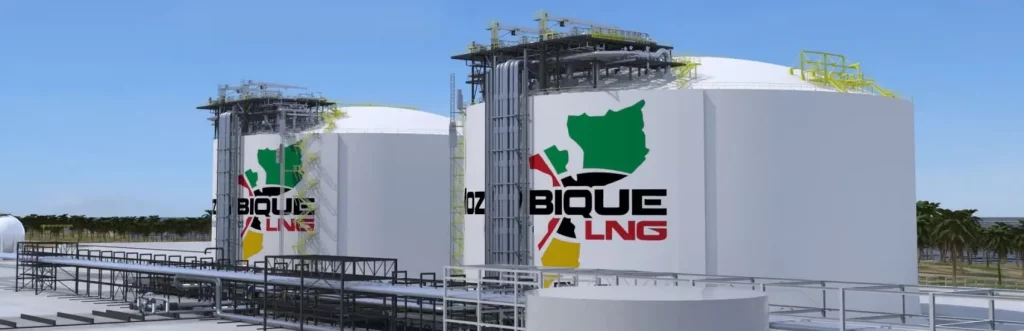
Once liquefied, the LNG is transferred to large, specially designed storage tanks, where it is kept at approximately -162°C, ready for transportation.
The tanks are specifically designed for the safe storage of LNG at very low temperatures. They use multiple layers of containment: an inner tank made of special steel holds the LNG, while a strong outer concrete structure provides additional protection.
The storage facilities are also equipped with systems that continuously monitor operating conditions and can safely shut down equipment if a problem is detected.
LNG shipping and transportation
From the onshore storage tanks, LNG is transferred through cryogenic pipelines to the export jetty, where it is loaded onto dedicated LNG carriers for transportation to international markets.
LNG carriers are highly specialized vessels designed for the safe and efficient transportation of LNG. Their insulated cargo containment systems maintain the LNG at approximately -162°C throughout the voyage.
These vessels connect LNG production facilities with receiving terminals around the world, providing access to international energy markets. Typical voyage times from Mozambique range from approximately seven days to northern India to seventeen days to Japan.
At the receiving terminal, the LNG is unloaded and stored before being regasified, converting it back into natural gas. The gas is then delivered into the local transmission network for distribution to end users.
This integrated supply chain enables natural gas to be transported efficiently from its source to customers around the world, while maintaining high standards of safety, reliability and environmental performance.